OpenAI has begun testing clearly labeled advertisements inside ChatGPT, marking the company’s first major step toward monetizing one of the world’s most widely used conversational AI platforms.
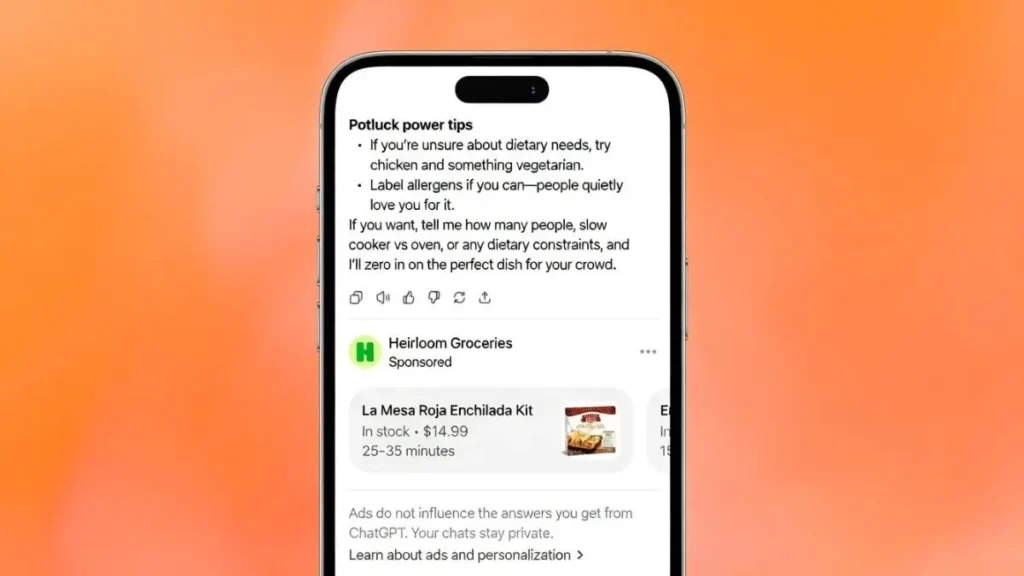
The company confirmed on Tuesday that it is rolling out a limited live test in which sponsored messages will appear directly within the ChatGPT app for select users. The ads are displayed in a dedicated section beneath the chat interface and are kept visually separate from ChatGPT’s responses, a design choice intended to avoid confusion between advertising and AI-generated content.
According to OpenAI, the initial ad rollout will apply only to logged-in users on the free tier and its lower-cost Go subscription. Higher-priced paid plans will remain ad-free during the test.
How the Ads Work
OpenAI said the ads will not appear inside ChatGPT’s answers and will not influence how the model responds to user questions. Advertisers will also not have access to user conversations.
Instead, ads are selected based on signals OpenAI believes indicate relevance, including conversation topics, prior chats, and previous ad interactions. For example, a user researching recipes or meal planning may see ads for grocery delivery services or meal kits.
If multiple advertisers are eligible to appear for a given topic, OpenAI said it will prioritize the most relevant option. The company emphasized that ad targeting is designed to remain separate from the core functioning of the AI system.
User Controls and Privacy
Users will have granular control over their ad experience. OpenAI said users can dismiss ads, view and delete a separate ad history, and manage interest data associated with advertising. Personalization can also be toggled on or off.
When personalization is turned off, ads will be limited to the context of the current chat rather than drawing on past interactions. Free-tier users will also be able to opt out of ads entirely in exchange for reduced daily message limits or by upgrading to a paid subscription.
OpenAI stressed that advertising data is handled separately from conversation data and that advertisers will not be able to target users based on private chat content.
Why the Move Matters
ChatGPT has become one of the largest consumer-facing AI platforms globally, with hundreds of millions of users. Even a limited advertising rollout could represent a significant shift in how conversational AI products are funded.
Until now, OpenAI has relied primarily on subscriptions and enterprise partnerships for revenue. Introducing ads suggests the company is exploring a model closer to traditional consumer internet platforms, where advertising helps support free access at scale.
For brands, the move opens the door to a new channel where ads appear alongside high-intent user activity, such as research, planning and decision-making.
What Comes Next
OpenAI described the rollout as a test and said it will evaluate user feedback and performance before expanding the program further. The company did not provide a timeline for broader availability or indicate whether ads would eventually appear in additional formats.
For now, OpenAI’s experiment signals that conversational AI is entering a new phase—one where sponsored content, user choice and AI interaction are being tested together at massive scale.
1 thought on “OpenAI Begins Testing Ads Inside ChatGPT in First Monetization Move”