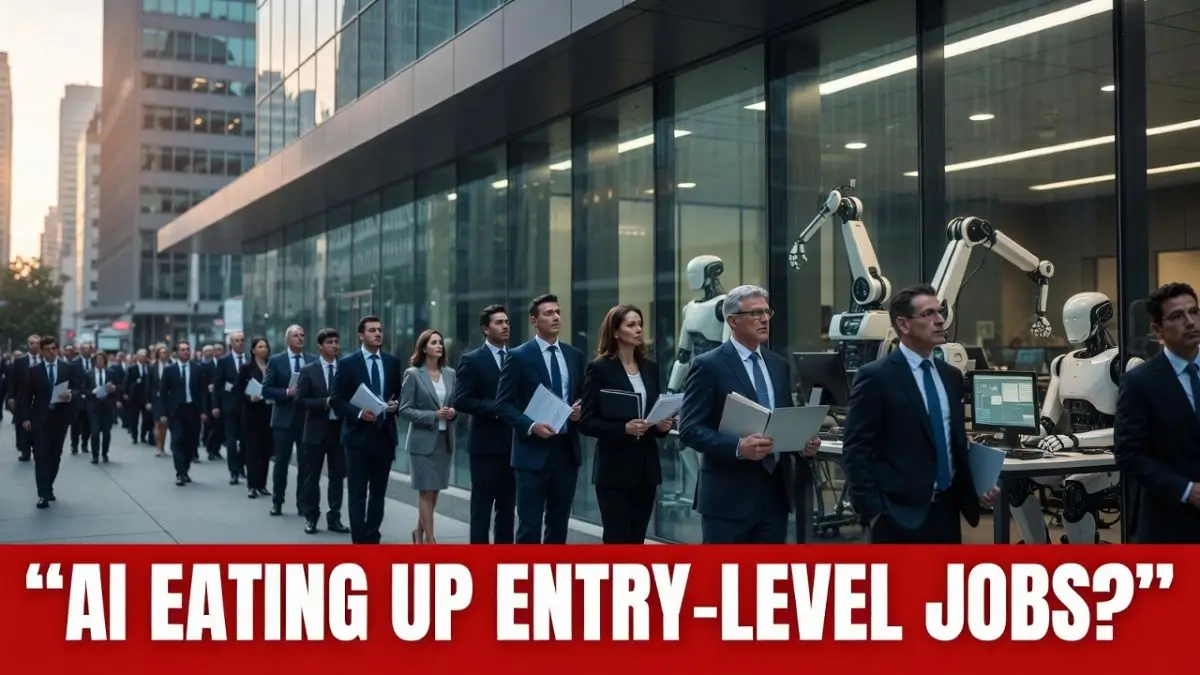
Recent media reports and labor market analyses indicate that entry-level job opportunities may be shrinking in both the United States and India, raising concerns about how artificial intelligence is reshaping the early-career job landscape.
According to figures discussed in coverage by business news outlets and cited by Firstpost, entry-level job postings in the United States have declined by an estimated 30% to 35% between 2023 and 2025. The same reports suggest internship openings may have fallen by roughly 15% over the past two years. Separate analyses referenced in media coverage indicate that hiring of fresh graduates in 2024 was nearly 50% lower compared with pre-pandemic levels.
While the exact scale of the decline varies across industries and sources, labor market observers broadly agree that hiring for early-career roles has slowed.
AI’s Growing Role in Workplace Automation
Industry analysts increasingly link this shift to the rapid adoption of artificial intelligence tools. AI systems are now capable of performing many tasks traditionally handled by junior employees, including data entry, basic coding, drafting documents and managing routine customer inquiries.
Business surveys reported by multiple outlets suggest that a significant share of executives plan to expand AI use in functions historically staffed by entry-level workers. Employers cite efficiency gains and cost control as key motivations.
However, experts caution that automation is only one factor influencing hiring decisions. Broader economic pressures—including high inflation, slower growth and corporate cost-cutting—are also contributing to tighter recruitment.
Concerns About Long-Term Workforce Development
Some analysts warn that a sustained decline in entry-level hiring could create long-term workforce challenges. Entry-level roles have traditionally served as training grounds where employees develop practical skills, business judgment and industry experience.
Without those early-career opportunities, companies may face a narrower pipeline of experienced professionals in the future.
There are also documented risks associated with heavy reliance on AI systems. Surveys cited in media coverage suggest some workers have experienced rejected outputs, security concerns and customer complaints linked to AI-generated errors. These findings highlight the continuing need for human oversight.
A Shift Rather Than a Disappearance
Rather than disappearing entirely, entry-level work may be evolving. Analysts suggest new roles could increasingly focus on supervising AI systems, validating outputs and managing digital workflows instead of performing repetitive tasks.
While the long-term impact remains uncertain, the broader trend is clear: the structure of early-career employment is changing. As artificial intelligence becomes more integrated into business operations, both employers and graduates may need to adapt to a workforce where technology and human oversight operate side by side.
2 thoughts on “Reports Suggest Decline in Entry-Level Jobs as AI Reshapes Hiring”