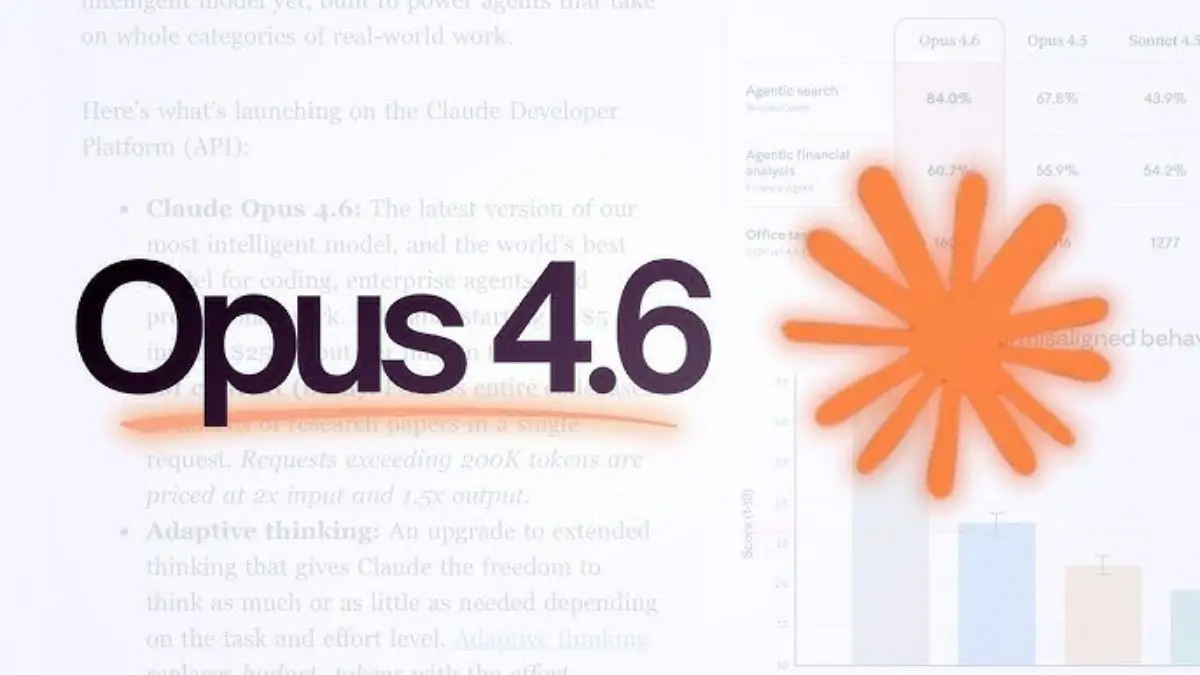
Artificial intelligence is moving fast, but for many people, it still feels complicated, technical, and slightly intimidating. Most AI tools promise productivity, yet often require coding knowledge or complex setups to unlock their real power. This is exactly the gap Claude Opus 4.6 is trying to fill.
Instead of targeting only developers, Claude Opus 4.6 focuses on professionals, creators, educators, and business owners who want AI to work for them, not the other way around.
And that’s why its release has quietly become one of the most talked-about moments in the AI space.
Why Claude Opus 4.6 Is Getting So Much Attention
The biggest reason people are paying attention to Claude Opus 4.6 is simple: it handles scale and complexity without demanding technical skills.
Many AI tools perform well on small tasks, but start to struggle once you throw large documents, long projects, or multi-step workflows at them. Claude Opus 4.6 was clearly designed with these real-world challenges in mind.
Its massive context window allows users to work with large volumes of information at once, making it suitable for long reports, multiple PDFs, research material, and ongoing projects that evolve over time.
Handling Large Context Without Losing the Plot
One of the standout capabilities of Claude Opus 4.6 is its ability to manage extremely long context. With support for up to one million tokens, users don’t need to constantly summarize or break their work into smaller pieces.
This becomes especially useful when working on:
- Long-term client projects
- Research-heavy documents
- Strategy planning that spans weeks or months
Instead of repeating instructions or re-uploading files, users can continue working in a single, consistent flow.
Adaptive Thinking That Feels Surprisingly Natural
Another area where Claude Opus 4.6 feels different is its adaptive thinking. Rather than responding the same way to every prompt, it adjusts its approach based on the task.
For example, when planning a campaign, it can think strategically. When analyzing data, it shifts into a more structured, analytical mode. This flexibility makes interactions feel less like issuing commands to software and more like collaborating with a smart assistant.
Built-In Excel and PowerPoint Integration
For many professionals, work lives inside spreadsheets and presentations. Claude Opus 4.6 acknowledges this reality by offering direct integration with tools like Excel and PowerPoint.
This means users can:
- Analyze spreadsheet data without manual formulas
- Generate insights from raw numbers
- Create structured presentation content faster
Instead of jumping between tools, AI becomes part of the workflow you already use.
Autonomous Task Execution: Less Micromanagement
Claude Opus 4.6 also introduces a higher level of autonomy. Once given a goal, it can initiate and manage tasks on its own, following a logical sequence without constant user input.
For busy professionals, this reduces repetitive instructions and allows them to focus on decision-making rather than execution.
Designed for People Who Don’t Code
Perhaps the most important reason Claude Opus 4.6 stands out is its no-code-friendly design. Users don’t need programming knowledge to benefit from advanced AI capabilities.
This opens the door for:
- Agency owners managing complex workflows
- Freelancers handling proposals and reports
- Educators creating course structures
- Content creators planning scripts and calendars
AI becomes accessible, not exclusive.
Claude Opus 4.6 vs Other AI Models
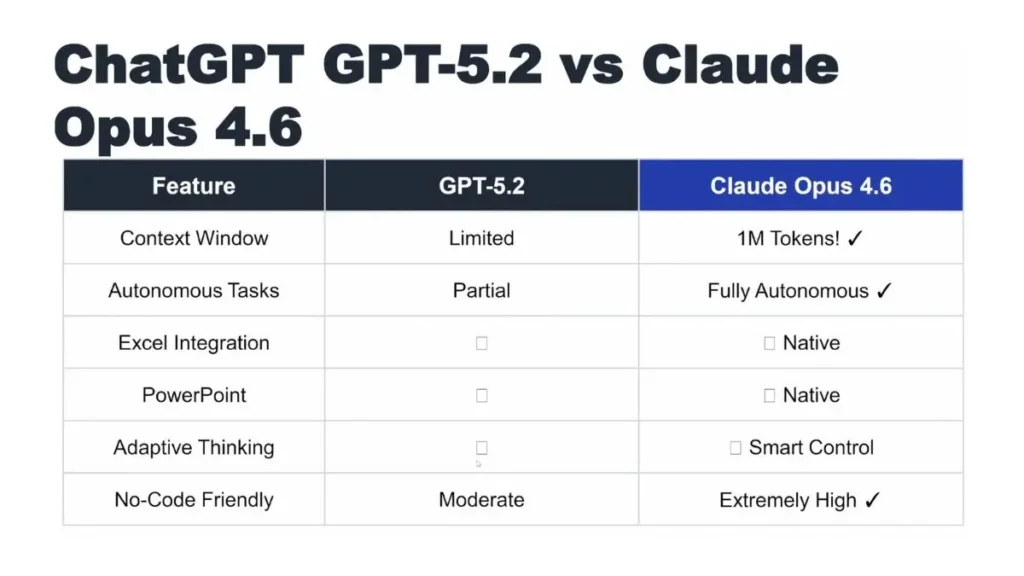
When compared with models like GPT-5.2, Claude Opus 4.6 feels more focused on long-form work and autonomy. Its larger context window and structured task handling give it an edge for complex projects, while other models may still excel in conversational or quick-response scenarios.
The choice ultimately depends on how you plan to use AI in your daily work.
Pricing and Practical Considerations
Claude Opus 4.6 currently offers free credits for new users, which is a good way to explore its capabilities. However, heavy usage, especially via API, can become expensive depending on project size.
For professionals working on large or long-term tasks, upgrading to a professional plan makes more sense than relying only on free credits.
Who Should Use Claude Opus 4.6
Claude Opus 4.6 is best suited for people who:
- Work with large documents or datasets
- Manage long-term projects
- Want AI help without coding
- Prefer structured, thoughtful outputs over quick replies
If your work involves planning, analysis, or content at scale, this tool can significantly reduce friction.
A New Direction for Practical AI
Claude Opus 4.6 doesn’t try to impress with flashy promises. Instead, it focuses on making AI genuinely useful for real people. By removing technical barriers and handling complexity quietly in the background, it signals where practical AI tools are heading next.
For anyone tired of AI tools that feel powerful but inaccessible, Claude Opus 4.6 is worth exploring.
1 thought on “Claude Opus 4.6: The AI Tool That Finally Makes Sense for Non-Coders”