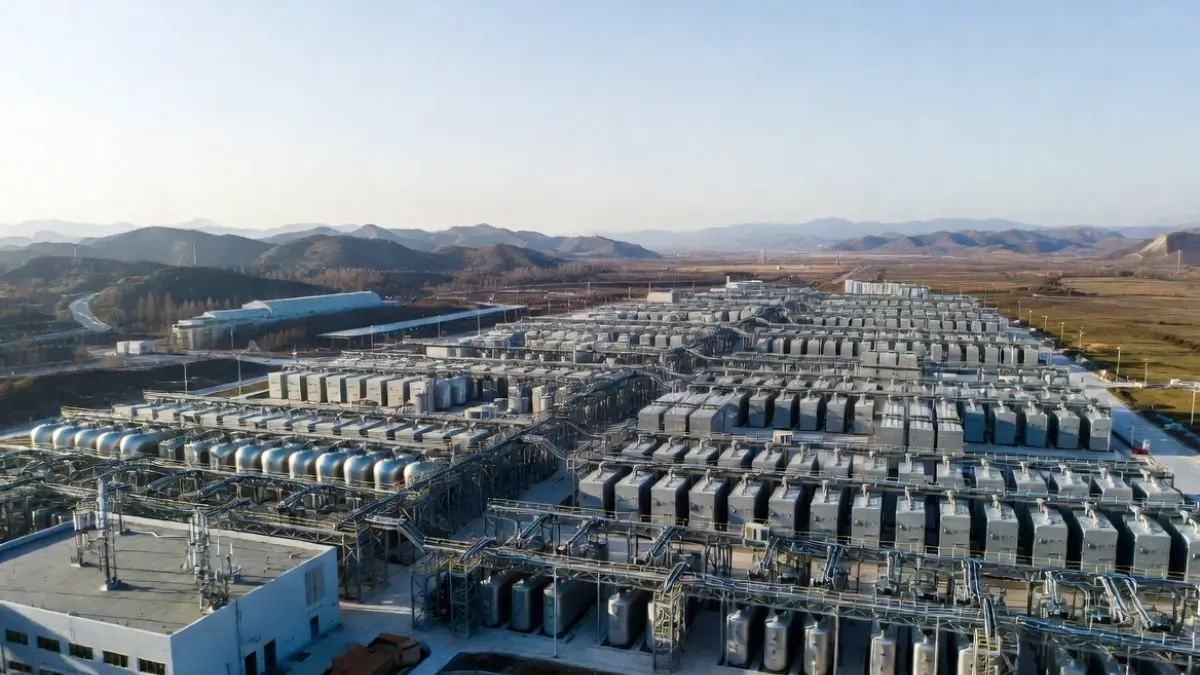
China has taken a major step forward in large-scale energy storage with the launch of what is now considered the world’s largest AI-driven battery cluster, strengthening the country’s push to stabilize renewable power and modernize its electricity grid.
At the end of December 2025, the Envision Jingyi Chagan Hada energy storage station was successfully connected to China’s national grid, according to PV Magazine. The flagship site alone offers a capacity of 4 gigawatt-hours (GWh), completing a wider 12.8-GWh storage network developed by Envision in China’s Inner Mongolia region.
Inner Mongolia’s Role in China’s Energy Strategy
Inner Mongolia has emerged as one of China’s most important renewable energy hubs, often described as the country’s “green power bank.” The region produces vast amounts of wind and solar energy, frequently exceeding local demand. Until recently, much of this surplus electricity went unused due to limited storage and transmission flexibility.
By deploying massive battery storage systems, China aims to capture this excess clean energy and transform Inner Mongolia into a stable, high-capacity power source for the rest of the country. The newly completed cluster allows renewable energy to be stored during peak generation and released when demand rises, reducing waste and improving grid reliability.
Beyond the central Chagan Hada site, the storage network spans multiple districts including Alxa League, Xilingol League, Ulanqab, Hohhot, Ordos and Bayannur. With these additions, Envision’s total battery storage footprint in the region now exceeds 14 GWh, making it one of the largest concentrated deployments of its kind anywhere in the world.
Industrial Ecosystem and Grid Validation
To support the scale of the project, Envision built a localized industrial ecosystem that covers the entire supply chain—from battery manufacturing and system integration to automated site operations. This approach is designed to reduce deployment time while improving operational consistency across facilities.
Official reports released in early January confirmed that the flagship 4-GWh installation passed all grid-connection tests on its first attempt. The system successfully completed demanding “three charge and three discharge” cycles, along with a continuous 72-hour operational test, setting a new domestic benchmark for large-scale energy storage validation, according to PV Magazine.
Policy Support and Grid Modernization
The project’s activation coincided with new policy guidance from China’s National Energy Administration and the National Development and Reform Commission. The updated directives focus on improving the quality and resilience of power grid expansion, encouraging advanced regulation technologies and better coordination of large-scale energy resources.
Particular emphasis has been placed on grid-forming technologies and research into energy storage systems capable of operating reliably in extreme weather and harsh environmental conditions—an important consideration for regions like Inner Mongolia.
AI at the Core of the System
What sets this battery cluster apart is its AI-driven architecture. Envision’s system combines grid-following and grid-forming technologies within a three-layer digital framework that allows near-instant synchronization with the grid. This significantly reduces setup time and minimizes the risk of voltage or frequency instability.
According to reports, the system can begin supporting the grid almost immediately after being powered on, a capability that is especially valuable for gigawatt-scale installations.
The cluster is also designed to participate directly in China’s electricity spot market. By integrating trading algorithms with grid-stabilization software, the system continuously forecasts demand, adjusts output and refines operations autonomously. Envision describes this approach as “Physical AI,” embedding intelligence directly into battery cells and operational layers.
The company estimates that this AI-enabled optimization could increase the project’s total financial returns by more than 20% over its operational lifetime.
A Signal for the Global Energy Transition
China’s launch of the world’s largest AI-powered battery cluster highlights how energy storage is becoming central to the global renewable transition. As countries expand wind and solar capacity, large-scale storage is increasingly seen as the missing link that can turn intermittent generation into reliable power.
With this deployment, China is signaling not only its commitment to clean energy but also its ambition to lead in next-generation grid technology—where AI, storage and market integration converge.