
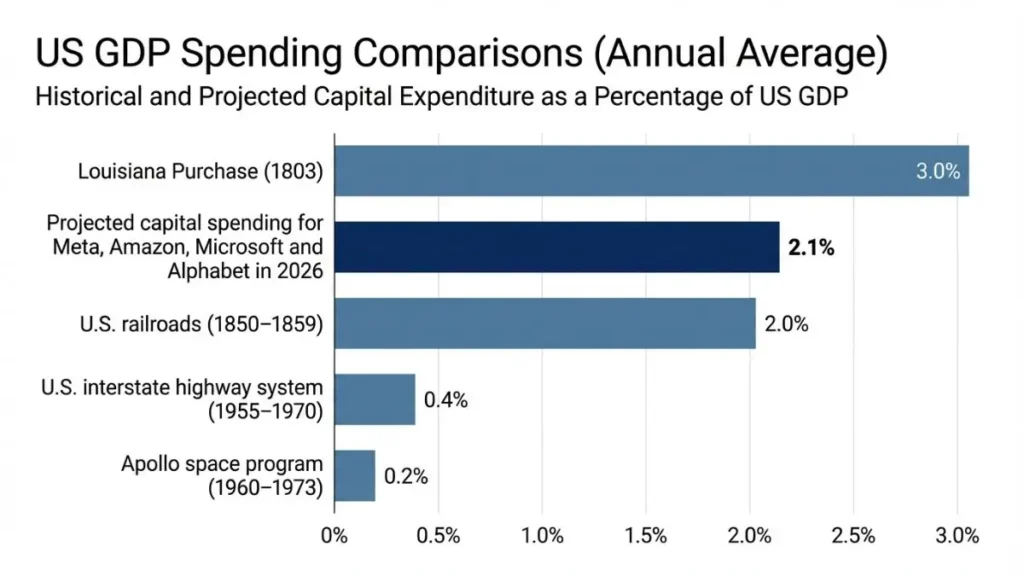
Artificial intelligence is no longer just a technology trend—it is rapidly becoming a force large enough to reshape the US economy itself. By 2026, America’s biggest technology companies are projected to spend an amount on AI that would equal 2.1% of US gross domestic product, a scale of investment rarely seen outside of landmark moments in US history.
The projected spending comes from a small group of firms—Meta, Amazon, Microsoft and Alphabet—that are racing to build and control the infrastructure powering the AI boom. Combined, their planned investments underscore how central AI has become to corporate strategy and long-term economic growth.
A Scale That Rivals Historic US Investments
Measured against US GDP, the scale of projected AI spending stands alongside some of the most consequential investments in American history. The Louisiana Purchase, which doubled the size of the United States in 1803, cost roughly 3.0% of GDP at the time. The rapid expansion of US railroads in the 1850s absorbed about 2.0% of GDP, helping bind the country together economically and geographically.
More recent national efforts appear modest by comparison. The interstate highway system, one of the largest public infrastructure projects of the 20th century, averaged around 0.4% of GDP between 1955 and 1970. Even the Apollo space program, which put humans on the Moon, accounted for roughly 0.2% of GDP at its peak between 1960 and 1973.
Against that backdrop, Big Tech’s AI investment push is extraordinary. Unlike past projects driven by government spending, this wave is being led almost entirely by private companies.
What Is Driving the Spending Surge
Most of the money flowing into AI is not being spent on software alone. The bulk is directed toward data center construction, advanced servers, networking equipment and semiconductor capacity—the physical backbone required to train and run large AI models at scale.
As demand for generative AI tools accelerates, companies are scrambling to secure computing power before rivals do. Control over AI infrastructure is increasingly seen as a competitive moat, similar to railroads in the 19th century or highways in the mid-20th century.
Financing also plays a role. Many firms are locking in long-term investments now to avoid future bottlenecks in power supply, chips and real estate as AI adoption spreads across industries.
Why the Comparison Matters
Looking at AI spending through a GDP-based lens helps standardize comparisons across very different historical eras. Data drawn from government archives, corporate disclosures and academic research shows that AI investment is approaching levels typically associated with nation-shaping initiatives.
The comparison also highlights a shift in economic power. Whereas past transformative investments were largely coordinated by governments, today’s AI boom is being shaped by a handful of corporations whose budgets rival those of entire public programs.
As AI continues to expand into healthcare, finance, manufacturing and defense, the economic footprint of these investments will likely extend far beyond the tech sector. The question facing policymakers and investors alike is whether this historic spending surge will deliver productivity gains comparable to past breakthroughs—or concentrate economic power in unprecedented ways.
News Source:- wsj.com